

Prime Minister Mathew Wale has delivered a strong message to world leaders ahead of the United Nations Climate Change Conference (COP31), calling for greater accountability, direct climate finance, and stronger commitments to protect vulnerable island nations.
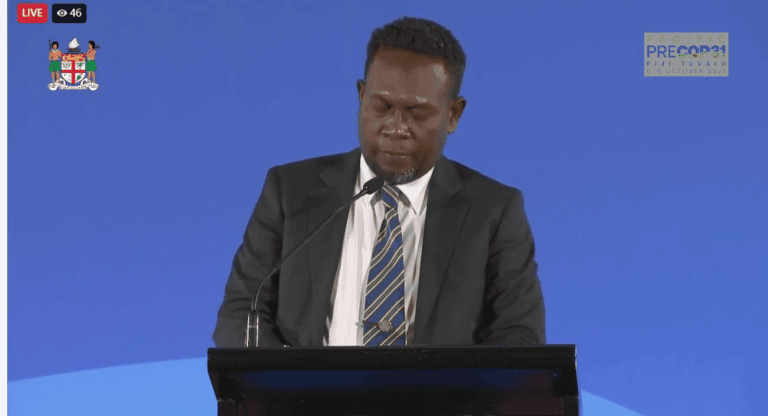
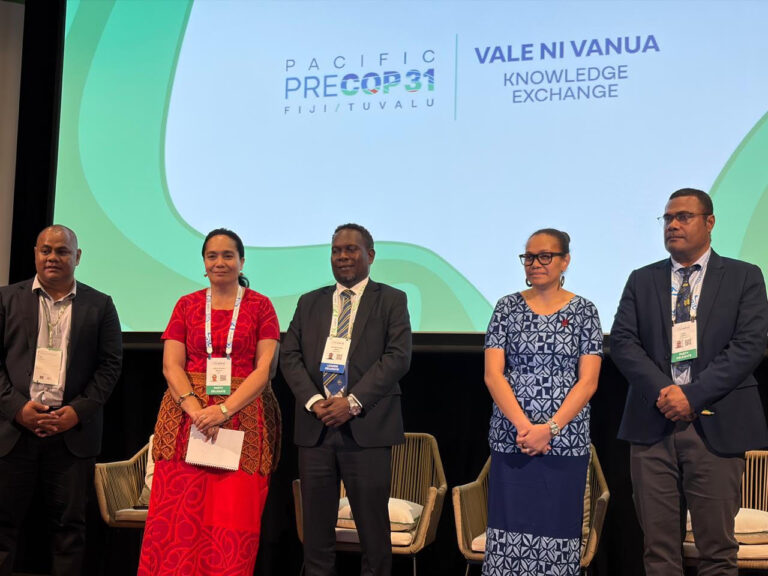
Addressing the Leaders’ Plenary of the Pacific Pre-COP31 meeting at the Sheraton Fiji Golf & Beach Resort on Denarau Island, Nadi, on Tuesday evening, Mr Wale said Small Island Developing States (SIDS) could no longer afford delays in global climate action.
His remarks came shortly after returning from Tuvalu with 12 Pacific heads of state and government, where the visible impacts of sea-level rise reinforced the urgency of the climate crisis.
“Tuvalu’s message was stark,” he said.

“The world should have acted long before Paris, but it did not. It must act now.”
Mr Wale noted that COP31 marks the 31st year of climate negotiations and the tenth conference since the Paris Agreement, yet scientific evidence indicates the world is still on course to exceed the 1.5°C warming threshold.
“Our actions have lacked the decisiveness and ambition that this crisis demands,” he said.
“We have a deficit of climate action.”
He said the BELAU Pacific Leaders’ Declaration calls for urgent and inclusive action to keep the 1.5°C target alive, limit overshoot, and rapidly reduce global warming.
Turning to emissions reductions, Mr Wale said major polluting nations must take immediate and significant action.
“Thirty-one years of talks and ten years of Paris have not delivered its core goal. COP31 cannot be another talkfest,” he said.
“It is absurd that the path to modernisation and industrialisation comes with a licence to pollute the atmosphere and put lives at risk.”
“People are dying in Nepal. People are dying in cyclones across the Pacific.”
Mr Wale urged G7 nations to increase ambition in accordance with their historical responsibility while also calling on BRICS nations and major emerging economies to strengthen emissions reduction efforts.
He was particularly critical of continued fossil fuel subsidies, which the International Monetary Fund estimates at US$7.43 trillion.
“That is more than three times the US$2.1 trillion in total global climate finance in 2025,” he said.
“We are effectively paying to fuel climate overshoot. It is criminal. It is immoral.”
Finance Must Follow Vulnerability
Mr Wale said the current climate finance architecture continues to fail the countries most vulnerable to climate change.
“It allocates finance without sufficient regard to vulnerability,” he said.
“It is not reaching those most in need, nor is it being delivered at the scale or speed required.”
He argued that the shortfall was not due to a lack of global resources but rather a lack of political will.
“Global military expenditure reached almost US$3 trillion last year, more than 16 times all official development assistance, even as aid declined significantly,” he said.

“In just two weeks, the world spends more on arms than developed countries provide in an entire year of climate finance.”
Mr Wale endorsed the use of the Multidimensional Vulnerability Index (MVI) as a key tool for determining access to development and climate finance.
“We call on development partners, multilateral development banks and climate funds to adopt the MVI when assessing eligibility for development and climate funding,” he said.
He said climate finance must be locally driven, flexible, people-focused and channelled through strengthened national systems.
While acknowledging that loans may sometimes be unavoidable, he warned against placing additional debt burdens on vulnerable island nations.
“If loans cannot be avoided, they must be on the most accessible terms and calibrated according to vulnerability,” he said.
“One size does not fit all.”
From Pledges to Delivery
Mr Wale also called for greater transparency and accountability in climate financing commitments.
“We must move beyond delayed pledges that generate headlines but fail to deliver results,” he said.
“We need clear mechanisms that hold partners accountable, with published disbursement timelines and independent tracking of commitments.”
He joined regional leaders in calling for increased support for the Pacific Resilience Facility and stressed that ambition must translate into tangible action.

“As the 1.5-degree threshold faces imminent overshoot, ambition must mean implementation,” he said.
“To move from pledges to real-world survival, we must urgently strengthen paragraphs 6, 8 and 11 of the declaration. In its current form, I find it difficult to endorse.”
‘Words of Sympathy Will Not Save Our Islands’
Concluding his address, Mr Wale called for greater accountability, accelerated clean energy transitions and significantly increased investment in resilient infrastructure throughout the Pacific.
“Our region desperately needs sustainable and climate-resilient infrastructure,” he said.
“Words of sympathy will not save our islands.”
He said Pacific nations continue to face a “patronising paradox” in which the severity of their challenges is widely acknowledged but meaningful solutions remain diluted.
“For Small Island Developing States, the road to Antalya must be paved with structural accountability, direct climate finance and a binding ocean-climate nexus,” he said.
Source: Eddie Osifelo | Nadi, Fiji