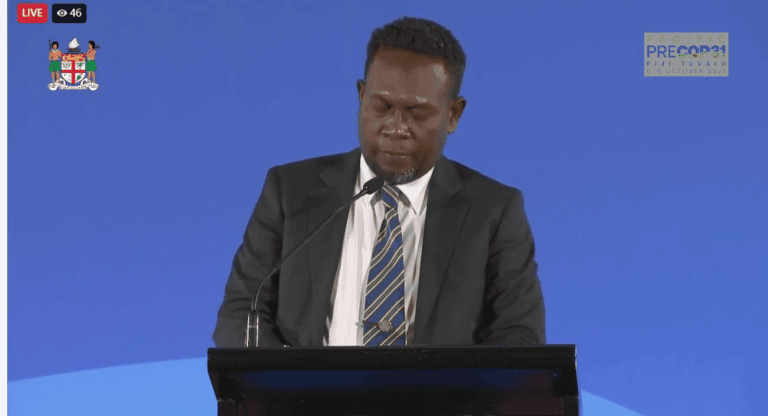


Minister for Environment, Climate Change, Disaster Management and Meteorology, Wayne Osopo Ghemu, has highlighted several challenges facing the implementation of the Solomon Islands’ first-ever Disaster Risk Financing Strategy (DRFS), despite significant progress in strengthening the country’s financial resilience against disasters and climate-related shocks.
Speaking during a panel discussion on Financial Protection Against Climate-related Shocks at the Sofitel Fiji Resort & Spa in Nadi on Thursday, Minister Ghemu said capacity constraints remain a key concern. Challenges include managing multiple financing instruments with varying conditions and reporting requirements, ensuring continuous renewal of financial protection coverage, and meeting the extensive policy requirements needed to access disaster financing.

The DRFS, launched in Honiara in June 2025 by the National Disaster Management Office (NDMO) and the Ministry of Finance and Treasury, provides a framework for the Solomon Islands to better prepare for, access, and deploy financial resources before, during, and after disasters.
Minister Ghemu said the country recognized that relying on emergency budget reallocations after disasters was no longer sustainable.
“Over the years, and with successive disaster events, we have realised that we needed money agreed before disasters, not negotiated after them,” he said.
To strengthen preparedness, the government has introduced several reforms, including the development of the country’s first DRF Strategy, regulations for the National Disaster Fund, and improvements to disaster management legislation.
The Minister noted that while these reforms are essential for improving preparedness and recovery efforts, many multilateral development banks require such policy frameworks to be in place before financial support can be approved.
He also highlighted improved collaboration between the Ministry of Finance and the NDMO, emphasizing that disaster risk financing must be integrated into national budget processes rather than treated solely as a disaster management issue.
As part of these efforts, the Government has established a Resilience Unit within the Ministry of Finance to oversee resilience financing initiatives, including Disaster Risk Financing.
The reforms mark a significant shift toward a proactive approach to disaster management, positioning Solomon Islands to better withstand the growing impacts of climate change and natural disasters while safeguarding national finances and supporting faster recovery efforts.
Source : Eddie Osifelo | Nadi, Fiji