


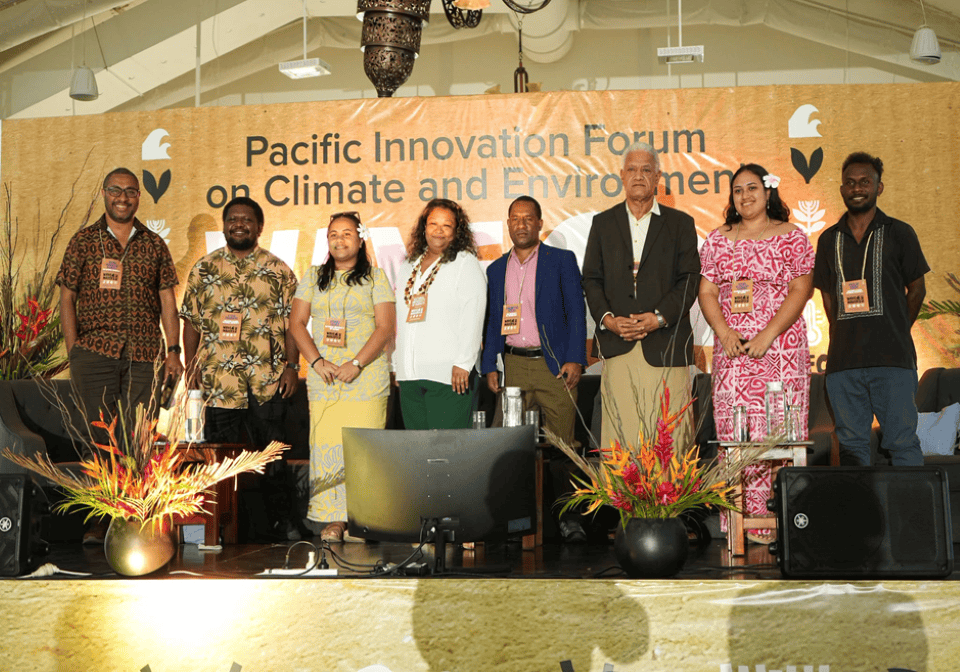
The Solomon Islands National University (SINU) was represented at the Pacific Islands Innovation Forum on Climate and Environment (PIFCE) 2026 in Vanuatu by Assistant Lecturer in GIS and Remote Sensing, Mr Steve Tahunipue, and final-year Bachelor of Environment Studies student, Mr Philip Bero.
Held under the theme, “Innovation in Academia: The Role of Pacific National Universities in Building Climate and Environmental Leaders,” the forum brought together universities, traditional custodians, policymakers, scientists, entrepreneurs, and innovators from across the Blue Pacific to explore solutions for climate resilience and sustainable development.
During the forum, Mr Tahunipue and Mr Bero shared perspectives on the role of Pacific universities in advancing climate education, research, and community-driven innovation.
In his presentation, Mr Tahunipue emphasised that Pacific universities must not only teach climate science but also demonstrate climate leadership by integrating traditional ecological knowledge into policies, strengthening regional research networks, developing shared curricula, and building long-term partnerships beyond donor-funded initiatives.
He highlighted four key pathways to strengthen climate education across the region: enhancing regional research collaboration, institutionalising traditional ecological knowledge, expanding student mobility opportunities, and strengthening youth and community partnerships through citizen science initiatives and practical activities such as mangrove restoration.
Mr Bero presented his research poster on integrating traditional knowledge with remote sensing for weather prediction and community resilience in Lokuru, Rendova Island. Following his presentation, he was selected to serve on the Pacific Islands Universities Supervisors Panel.
Mr Bero highlighted the importance of ensuring that climate and environmental studies are connected to real-world challenges, including pollution, sea-level rise, and food security, while respecting Pacific cultures and indigenous knowledge.
He also stressed that climate education should extend beyond universities to include schools, vocational institutions, community learning spaces, and church programmes so that climate awareness becomes part of everyday life.
As part of the forum’s innovation activities, Mr Bero joined students from the National University of Samoa, Tonga National University, Papua New Guinea University of Technology, and the National University of Vanuatu to develop and present a mobile application designed to provide early warning alerts for natural hazards.
The student team’s innovation received strong support from participants and was awarded the People’s Choice Award during the pitching competition on 2 July 2026. In recognition of their achievement, each team member received an Android smartphone, reflecting the forum’s commitment to supporting youth-led climate solutions.
The forum commenced on 27 June with a Climate Hackathon, where teams from six Pacific universities collaborated to develop practical solutions addressing climate challenges.
On 29 June, delegates visited the National University of Vanuatu, where students showcased their research and innovations through poster presentations. This was followed by practical climate action activities on 30 June, including mangrove planting, community clean-up activities, and visits to composting sites highlighting traditional practices, community participation, and nature-based solutions.
The official opening of the forum took place on 1 July with a panel discussion featuring representatives from the Papua New Guinea University of Technology (UNITECH), University of Papua New Guinea (UPNG), National University of Samoa (NUS), Tonga National University (TNU), Solomon Islands National University (SINU), and National University of Vanuatu (NUV).
The programme also included university exhibitions, government and private sector displays, and innovation poster presentations. Discussions focused on integrating traditional knowledge with modern science, recognising community challenges as opportunities for innovation, and empowering Pacific youth to create solutions for their communities.
The forum concluded on 3 July 2026, celebrating collaboration among Pacific institutions and reaffirming the collective commitment to building climate-resilient communities across the region.
Through the participation of Mr Tahunipue and Mr Bero, SINU continues to demonstrate its commitment to advancing climate leadership, sustainable development, and inclusive education in the Pacific.
Source: SINU Media Release