

Honiara, 22 July 2026: The National Disaster Council (NDC) has provided an update on ongoing recovery efforts following Tropical Cyclone Maila, as the Solomon Islands transitions from immediate response into the recovery phase.
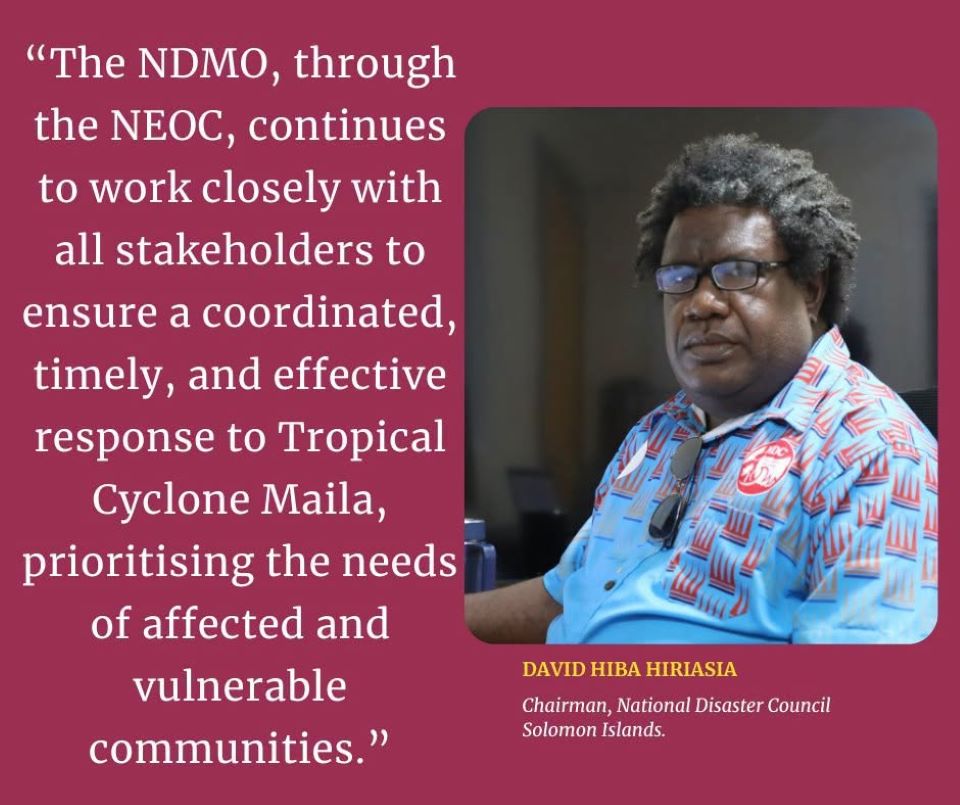
NDC Chair, Mr David Hiba Hiriasia, said recovery is a critical and complex component of disaster management that requires careful planning, accurate data, and coordinated action across multiple sectors.
“Recovery is not a quick or simple undertaking, contrary to what some may assume,” Mr Hiriasia said.
“Affected communities and Provinces can be reassured that the Council is working diligently to fast-track key processes, including securing Cabinet approval and collaborating closely with all stakeholders to ensure that recovery interventions are implemented in a transparent, accountable, and inclusive manner. Government has not forgotten its commitment and will continue to stand with all families and communities affected by Tropical Cyclone Maila.”
A key part of the process is the initial damage assessment, which is now completed and is undergoing validation and endorsement by Provincial Governments.
This process ensures that information is accurate and reflects the real impacts experienced by families and communities, guaranteeing no one is left behind as recovery interventions are designed and implemented.
Mr Hiriasia clarified that funding support for TC Maila recovery has been announced by several development partners, including the World Bank, Asian Development Bank, the Governments of Australia and New Zealand, the People’s Republic of China, and others.
“All funding announced is specifically for TC Maila recovery,” he said. “The State of Disaster declaration for Western and Choiseul Provinces issued due to the severity and extent of TC Maila’s impacts was the formal trigger enabling many partners to mobilise their support.”
The NDC clarified that TC Maila funds do not go into any NDC or NDMO account. Government-managed funds are channelled through the Solomon Islands Government Consolidated Fund, administered by the Ministry of Finance and Treasury in accordance with national financial regulations.
Some development partners are also delivering assistance through civil society organisations and other implementing agencies under their own recovery programmes.
The NDC does not hold a standing budget capable of responding to all disasters and relies on Government allocations and development partner support to mobilise resources. Any utilisation of TC Maila funds to respond to other disasters must be done strictly within the appropriate laws and financial regulations. Any new disaster event will require separate financial resources.
In addition to TC Maila recovery, the NDC is finalising a Cabinet Paper seeking financial support to respond to current El Niño conditions affecting the country.
This proactive step is necessary to ensure Government can mobilise resources early and reduce the impacts of prolonged dry conditions on communities.
Mr Hiriasia reminded the nation that Solomon Islands will continue to face disasters, and climate change will intensify their severity. He called on families, communities, Provincial Governments, and ministries to play their part in strengthening national resilience.
“Homes, clinics, schools, and public buildings must be constructed to proper standards, and risks must be carefully considered in all development decisions,” he said.
“We must be proactive, not reactive, and I urge communities to prepare for any future disasters. Personal and community efforts to prepare and mitigate impacts help protect lives and reduce the overall cost and complexity of Government response during disasters. This shared responsibility is essential to building a safer and more resilient nation.”
The Council acknowledged and sincerely thanked all individuals, churches, communities, business houses, and development partners who have supported those affected by Tropical Cyclone Maila.
“Your contributions — whether through food and non-food items, logistical assistance, or financial resources — have played a vital role in sustaining families during the immediate response phase and continue to complement Government’s ongoing recovery efforts,” Mr. Hiriasia said.
Source: Government Communication Unit – Solomon Islands